
From Billable Hours to Boundless Scale: Corporate Law’s Next Rewrite

Resharing a piece that my partner Priscilla and I published on Redpoint’s content hub.
For most employees and execs alike, “we should get that in writing” is the moment the deal stops feeling exciting and starts feeling expensive. Yet it happens constantly in the unglamorous moments that actually power the economy. A vendor contract needs redlining by EOD. A customer demands a nonstandard indemnity clause. An employment issue requires immediate post-holiday-party attention (oops!). Corporate law isn’t a rare event. It is, in fact, the operating system beneath every purchase order, partnership, hire, and exciting product launch.
Which makes it all the more ironic that while Americans spend over $400Bn annually on legal services, most companies still can’t access counsel when they actually need it. For all its criticality and cost, the legal function within most companies remains stuck in a bygone era of manual labor and mystery pricing. If you’re a Fortune 500, you can paper over the friction with headcount and seven-figure (or more) outside counsel budgets. But for everyone else – from Seed-stage startups to the mid-market operators powering Main Streets across the country – the reality is stark. Pay up, wait, or risk it with “good enough” templates and hope-and-pray tactics.
For years, this has been the accepted cost of doing business, albeit with a healthy degree of chagrin. But today AI is turning this equation upside down. Following the transformation of meaty categories like call centers and engineering, corporate law stands poised as the next company cost center whose operating model will be fundamentally rewritten.
Bridging the Mid-Market Gap
The corporate legal landscape is defined by massive spending that rarely reaches those who need it most. While the total market for corporate legal services currently sits at $194Bn, a significant $32Bn slice is already being diverted to outsourced contract work. We see a specific $9Bn opportunity in the mid-market alone for AI-powered outsourced operators. While this segment is currently underserved by traditional firms, it is also overlooked by existing enterprise-oriented AI apps, creating a particularly opportune wedge.
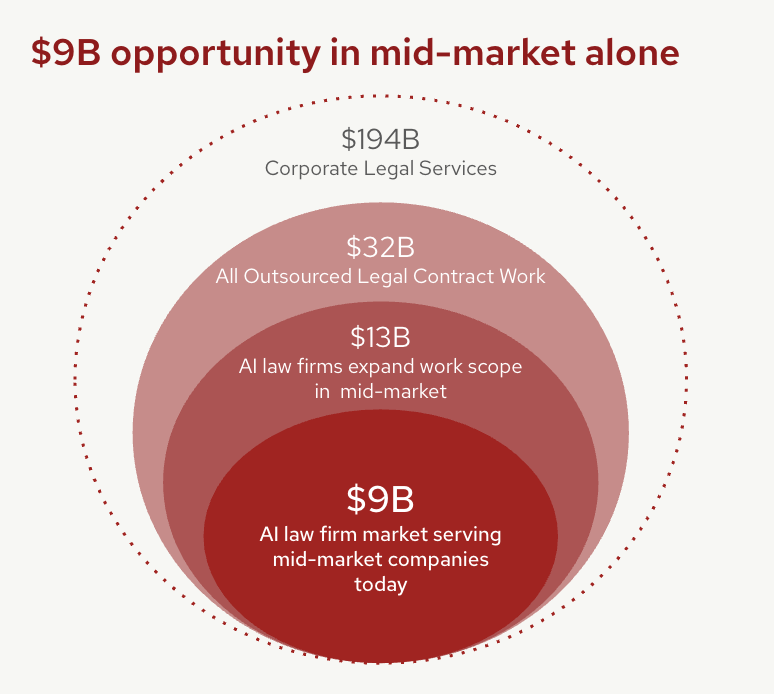
Market sizing methodology: We estimate 200K US mid-market enterprises (National Center for the Mid-Market, 2024) each review ~1.5K contracts / year, totaling 300M contracts annually. ~20% is handled by external counsel today (60M contracts). At ~$150/contract, this yields a current TAM of ~$9B. We project an incremental 10% shift to outsourced AI-enabled providers, expanding the future TAM to ~$13.5B (90M contracts × $150).
While the opportunity is seemingly glaring, foundation models and legal copilots alone likely won’t capture this opportunity. Why? Because business buyers, particularly the millions of small and mid-sized businesses nationwide who lack in-house counsel, don’t have the bandwidth to become their own lawyers, even with AI assistance. They’re seeking someone to do the work for them, not just help them do it themselves. And critically, they want the credibility that comes from a licensed professional signing off on the final product. Even the most sophisticated AI output doesn’t carry the same weight as a lawyer’s letterhead when you’re staring down a contract dispute or a regulatory audit in a new jurisdiction.
This is where tech-enabled law firms emerge as a distinct and exciting emerging category – not merely replacing human judgment, but strategically deploying it with enhanced leverage. By keeping humans in the loop at critical decision points while automating the repetitive heavy lifting, these firms can deliver the professional validation buyers require at price points that actually make sense for the mid-market. And as foundation models continue their relentless march toward capability, these firms become increasingly automated and margin-efficient over time, capturing the upside in a model-agnostic way as the underlying technology improves. It’s the difference between selling tools and selling outcomes. And in a world where time is increasingly scarce and business stakes remain high, it is outcomes that win – and what AI buyers are looking for across business functions.
What It Takes to Win as an AI-Enabled Law Firm
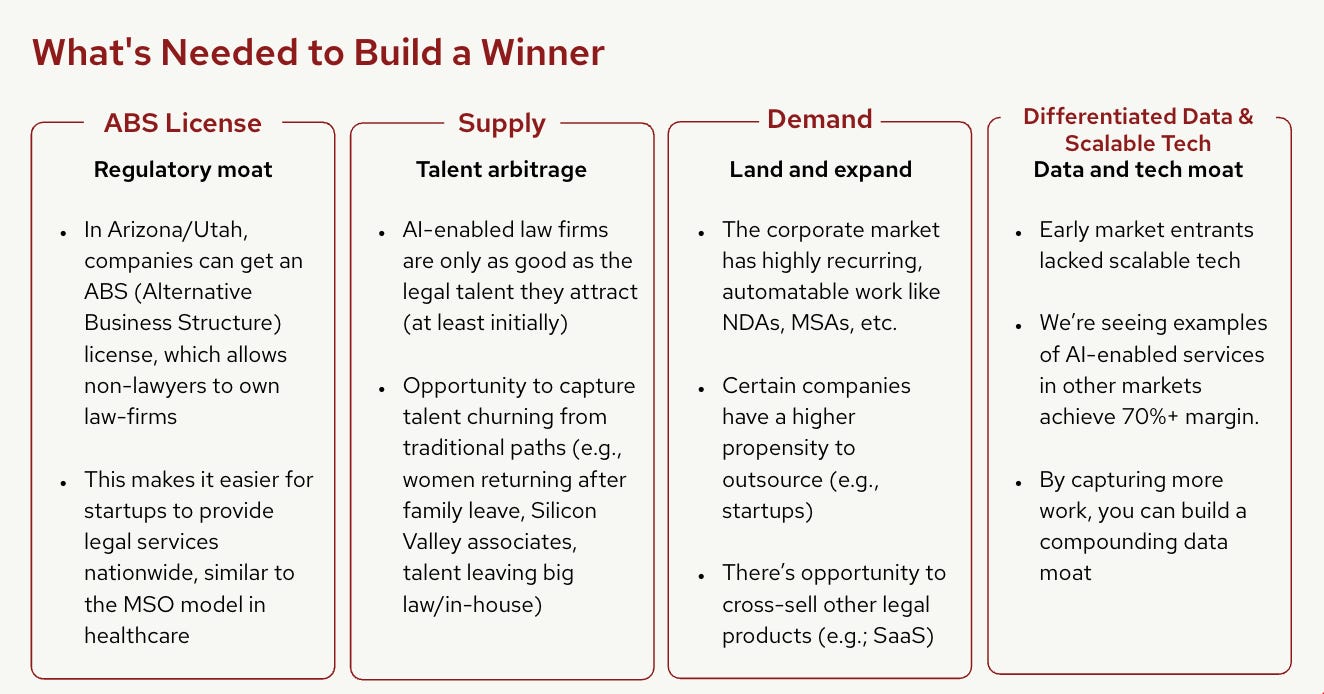
To build a dominant, category-defining AI law firm, companies must move beyond simple software and rethink the legal business model from the ground up. Success requires executing on four specific strategic pillars:
Regulatory Moat:
The most strategic founders are securing Alternative Business Structure (ABS) licenses in states like Arizona and Utah, which allow non-lawyers to own law firms. This regulatory unlock makes it possible for startups to scale legal services nationwide with venture-backed velocity rather than partnership-committee pace.
Talent Arbitrage:
An AI firm is only as good as the legal experts guiding it – and there’s a massive arbitrage opportunity in hiring top-tier talent fleeing the traditional Big Law grind. These lawyers bring the judgment and domain expertise that AI still lacks, providing high-level supervision that ensures quality while the models continue to learn. It’s the best of both worlds – experienced counsel without the legacy overhead.
Land and Expand:
The winning playbook starts narrow and scales wide. It focuses initially on high-volume, repetitive work like NDAs and MSAs where automation shines brightest and buyer hesitation runs lowest. By landing with startups and companies already comfortable outsourcing legal work, firms can prove their model with simple contracts before expanding upmarket into more complex, higher-margin work as both their technology and trust compounds.
Scalable Tech & Differentiated Data:
Many early legal tech ventures stumbled not on the vision but on the execution. They lacked the infrastructure to truly scale. Modern AI firms must hire top-tier engineering talent capable of building systems that automate the heavy lifting while maintaining quality controls. Done right, this enables 70%+ profit margins, a level of efficiency that makes traditional law firm economics look almost antiquated. With scalable infrastructure, companies can capture more work and eventually build a compounding data moat.
The legal industry has long operated on the assumption that expertise must be expensive and access must be limited. But as AI rewrites the economics of knowledge work, that assumption is crumbling. The question isn’t whether this transformation will happen. It’s who will build it – and whether they can scale fast enough to capture the market before the window closes.
If you’re as excited about this unlock as we are, we’d love to hear from you. Find me on LinkedIn or subscribe to this Substack for more.